Montclair Sports
Background
Most golf apps track scores. Few help players improve systematically.
Deuce GC is a comprehensive golf application focused on planning, structured practice, and performance insight. It connects course management, practice tracking, equipment decisions, and handicap analytics into a single feedback loop.
I built Deuce, for Montclair Sports Unlimited, as an AI-native product experiment: designing the system architecture, interaction model, and behavioral framework, while leveraging AI to accelerate engineering, code generation, debugging, and iteration. The goal was not just to ship features, but to explore how a senior product designer can use AI as a force multiplier across the full product lifecycle.

Why Deuce mattered
Golfers often practice without structure. They log rounds but don’t translate data into improvement.
This creates predictable failure modes:
Practice sessions disconnected from on-course weaknesses
Overemphasis on scores rather than skill deltas
Equipment decisions made without performance context
Analytics that inform but don’t guide action
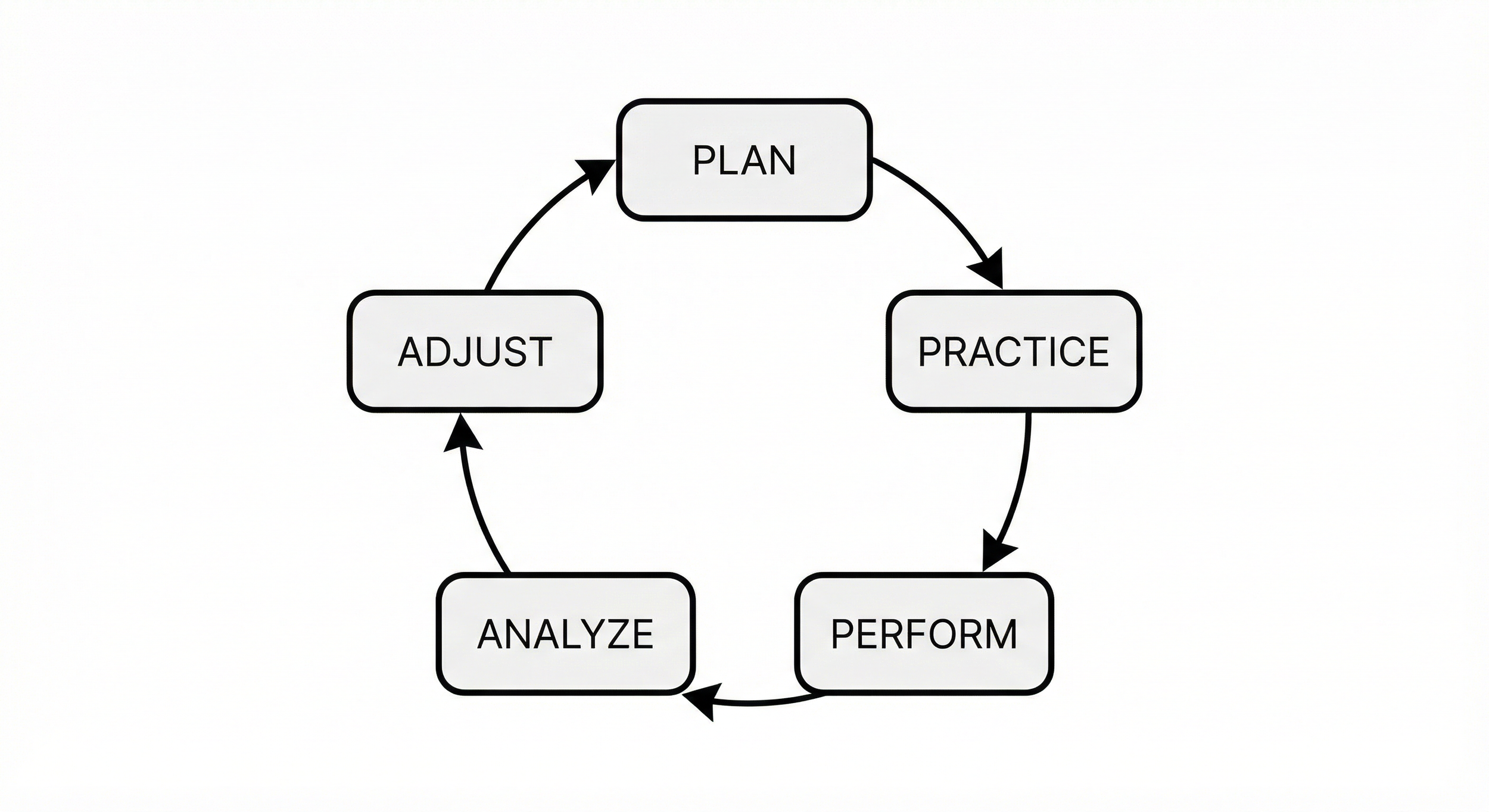
Deuce reframed the problem from “round tracking” to “behavioral system design.” The objective was to create a closed-loop model:
Plan → Practice → Perform → Analyze → Adjust
This system-level framing shaped every product decision.
My Role
I owned the product end-to-end as a Senior product designer, leveraging AI.
Defined the product strategy and behavioral model
Designed the information architecture and interaction system
Structured the data model and improvement loop logic
Used AI to generate, refactor, and validate production code
Implemented frontend and backend architecture
Set up analytics, observability, and CI/CD
Shipped and deployed independently
This was not a prototype exercise. The application is built with Figma, Cursor, Vercel, Supabase, and GitHub.
Problem
Golf performance data is fragmented.
Players manage:
Course notes in one place
Practice drills in another
Handicap tracking separately
Equipment decisions informally
No existing product integrated these into a structured improvement system. The problem was not a lack of data. It was a lack of integration and behavioral clarity.
The challenge was designing a system that:
Encourages intentional practice
Connects drills to real performance gaps
Translates analytics into specific next actions
Scales technically without overengineering
Initial Concept Exploration
Research + Ideation
I began by framing Deuce as a behavioral systems problem rather than a feature set. Through 50+ casual on-course interviews, contextual inquiry, competitive analysis, and heuristic reviews, I identified a structural gap: golfers track rounds but rarely operate within a disciplined improvement loop.
I synthesized findings through sketching and whiteboarding before touching UI, focusing on system coherence over screens:
Mapped the improvement cycle (Plan → Practice → Perform → Analyze → Adjust)
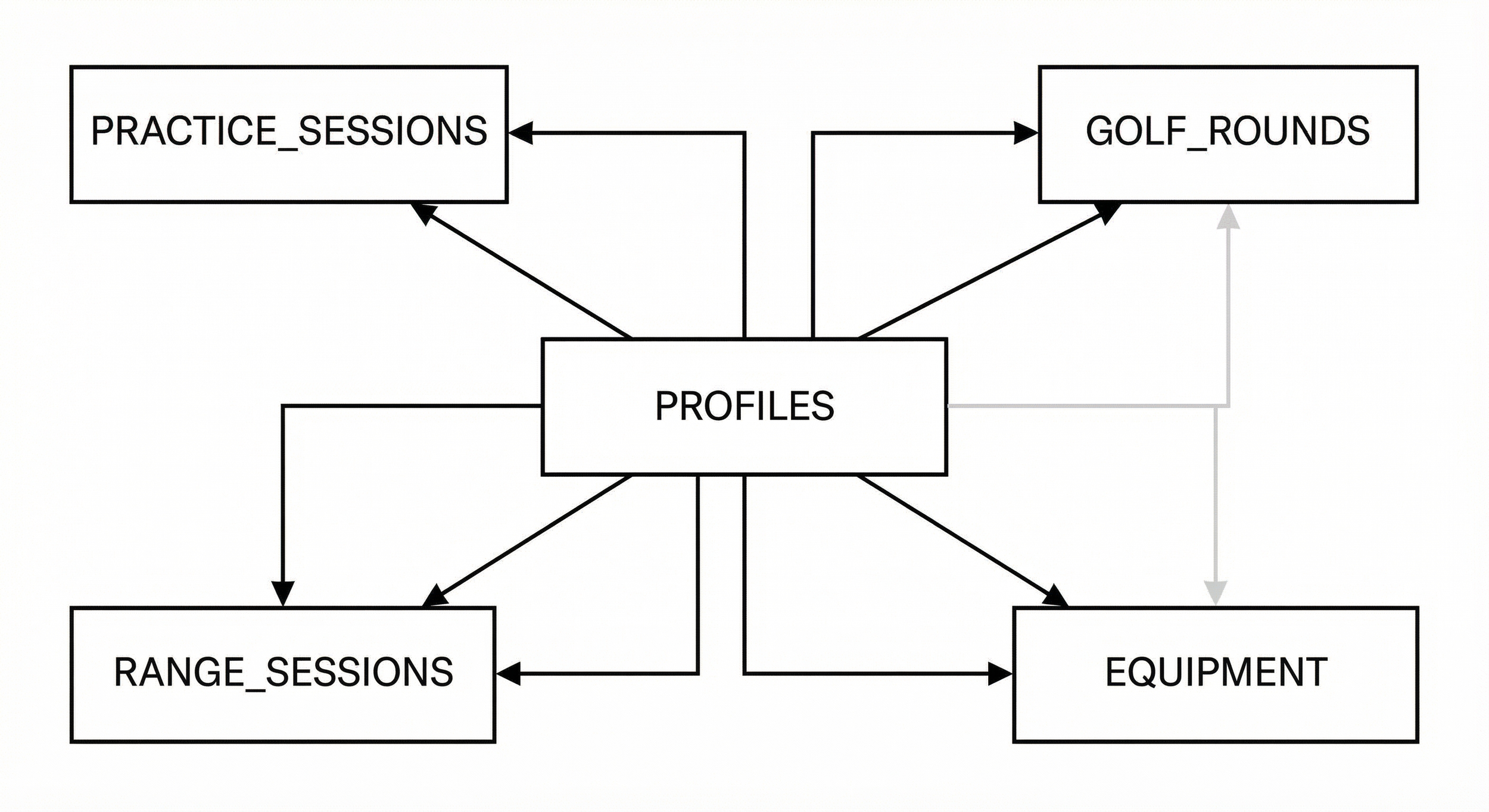
Defined core data objects: rounds, sessions, skills, equipment
Identified where analytics should inform action, not just report metrics
Clarified what needed to be a global state vs. contextual interaction
This ensured the product model was stable before visual exploration began.
AI-Assisted Prototyping
With the system defined, I moved into Figma and Figma Make to accelerate exploration. I generated and iterated on ~30 prototype variations through structured prompt synthesis, using AI to expand the solution space quickly.
Tested navigation hierarchies and card structures
Explored multiple analytics visualizations
Refined practice logging flows
Evaluated edge states and empty states
AI compressed iteration cycles, but all structural decisions remained deliberate and human-led.
Transition to Development
Once direction stabilized, I moved into production using Cursor and an AI-augmented workflow. The prototype concepts evolved into a structured Next.js + TypeScript architecture with Supabase, React Query, and Zustand deuce-app-summary.
Refactored the generated code into modular components
Structured server vs. client state separation
Established analytics and observability instrumentation
Used AI for debugging, refactoring, and architectural tradeoffs
This phase bridged design intent and implementation without introducing architectural drift.
Reflection on this phase
This concept exploration phase reinforced a principle in my practice: AI increases velocity, but clarity of system thinking determines quality. Research grounded the problem, whiteboarding stabilized the model, and AI expanded execution bandwidth. The leverage came not from automation, but from maintaining authorship of the system while accelerating its realization.
Constraints & Context
Solo execution: No formal engineering team. AI was leveraged as a collaborative coding partner.
System coherence: Course planning, practice sessions, analytics, and equipment needed a unified data model.
Performance sensitivity: Golf data requires recipient-level granularity (round, hole, shot, session).
Speed vs. architecture: Build fast, but avoid technical debt that could compromise the integrity of analytics.
Observability: The system needed instrumentation from day one (PostHog + Sentry)
Design Approach
Behavioral System First
Before building UI, I defined the improvement model:
Planning informs practice
Practice generates skill metrics
Rounds validate or falsify the training focus
Analytics guide the next cycle
This prevented feature sprawl and kept the product aligned around improvement rather than logging.
Data Model Integrity
Rather than treating scorecards as primary, I structured the system around:
Practice session objects
Skill categories
Equipment associations
Performance projections
Handicap became a trailing indicator, not the core value proposition
AI-Augmented Development
AI was used to:
Generate scaffolding for Next.js + TypeScript architecture
Refactor component logic
Validate Supabase data flows
Debug async state issues (React Query vs. local state separation)
Accelerate UI implementation using Tailwind + ShadCN, then migrated to MUI
Crucially, I did not delegate judgment to AI. I used it to accelerate execution while maintaining architectural ownership.
Technical Challenges
1. Geospatial and GPS integration
Range practice needed real-time distance from the user to targets. I integrated the browser Geolocation API with Turf.js for yardage arcs and Haversine distance calculations. Challenges included handling permission flows, enabling high-accuracy mode, and adjusting for elevation/wind when calculating “plays like” distance. The solution used a custom useGeolocation hook with clear separation between tracking state and UI.
2. Unified data model with recipient-level granularity
Golf data had to support round, hole, shot, and session levels. I designed a schema where practice_sessions (putting, chipping, pitching) and range_sessions share a consistent structure, with RLS enforcing user isolation. Handicap and analytics are derived from these sources rather than stored separately, keeping the model coherent and avoiding drift.
3. Server vs. local state separation
Avoiding race conditions between React Query (server state) and local UI state was critical. I used React Query for session fetches, caching, and invalidation, and kept transient UI (e.g. active set, shot logging) in local state. This separation reduced bugs when saving sessions and refetching history.
4. Session persistence and complex UI state
The Range Session Tracker manages sets, shots, GPS state, and miss-direction flows. Persisting this to Supabase without blocking the UI required careful sequencing: validate → save → invalidate queries → close. I used optimistic patterns where appropriate and explicit loading/error states for destructive actions.
5. Analytics at scale without overengineering
The Analytics Hub aggregates sessions across categories and time ranges. Rather than building a separate analytics backend, I used filtered client fetches and in-memory aggregation. For export, I used CSV generation (PapaParse) to keep the implementation simple while supporting user needs.
6. Solo execution with AI
Without a dedicated engineering team, I used AI for scaffolding, refactoring, and debugging. The main challenge was maintaining architectural ownership: I defined the data model, state boundaries, and component structure; AI accelerated implementation. Code review and targeted testing (e.g. RLS, auth flows) stayed under my control.
Codebase-Specific Details
Concrete and verifiable:
range-map-utils.ts – Turf.js for yardage arcs, elevation/wind adjustments.
RangeSessionTracker – ~900 lines, GPS + sets + shots + Supabase persistence.
CoursePlanner – ~890 lines, hole-level planning with geolocation.
AnalyticsHub – Recharts, time ranges, CSV export.
practiceSessions.ts – Centralized CRUD with RLS.
APP_REFERENCE.md – Single source of truth for product and design.
System Design Decisions
Key choices included:
React Query for server state; Zustand for local UI state separation
Centralized practice analytics to avoid per-feature logic duplication
Modular UI components aligned to a scalable design system
CI/CD automation via GitHub Actions + Vercel for rapid iteration
Solution
Deuce shipped as a structured golf performance platform with:
Interactive course management and shot planning
Practice session tracking with analytics
Equipment management
Handicap analysis with projections
Skill-development games
The product integrates these into a unified workflow rather than standalone features.
Outcome
Shipped and deployed.
Validated:
AI can meaningfully compress build cycles for experienced designers.
A Senior designer can operate across strategy, design, and engineering layers when architecture is thoughtfully scoped.
Behavioral system framing reduces feature creep and clarifies product identity.
Deuce serves as a working proof of concept for AI-accelerated product development—demonstrating that design leadership increasingly includes systems architecture and technical execution.
Reflection
This project reinforced a core belief:
AI does not replace product judgment. It amplifies it.
The real leverage was not code generation. It was about defining the right system, clearly structuring constraints, and using AI to move faster without compromising architectural integrity.
At the Senior level, the differentiator is not simply shipping UI—it is framing the problem correctly, designing coherent systems, and using modern tools responsibly to increase velocity while preserving product quality.