Quiet Hours
Background
Klaviyo enables brands to send high-volume SMS and email messages to customers across regions, time zones, and regulatory environments. As SMS adoption increased, so did the legal and operational risk associated with sending messages outside permitted hours.
Quiet Hours was created as a platform-level guardrail that allows brands to define time windows during which messages will not be sent; even if a campaign or flow is triggered. Instead, messages are queued and delivered once Quiet Hours end, based on each recipient’s local time.
This feature was especially critical for SMS, where violations can result in severe fines, class-action lawsuits, and carrier enforcement.
Why Quiet Hours mattered
Quiet Hours reduced SMS compliance risk across millions of messages by enforcing recipient-level sending restrictions—protecting brands from fines, Klaviyo from carrier penalties, and customers from unwanted late-night messages.
My Role
I led product design for Quiet Hours, a system feature that protects Klaviyo and customers from legal, reputation, and deliverability risks. I worked closely with Product and Content to turn unclear regulations and technical limits into a clear, usable control. As Product Designer, I:
Structured the end-to-end design process
Defined the interaction and mental model for Quiet Hours
Led concept divergence and synthesis
Ensured designs were system-compliant and immediately shippable
Partnered with Content to balance clarity, authority, and legal tone
My operating principle throughout was “shape small, ship fast, and reduce risk quickly.”
Team: Messaging Platform / Core Settings
Partners: Product Manager, Content Designer, Engineering Lead, Lead Designer (advisory)
Status: Shipped (Live)
Problem
Brands frequently underestimate the risk of message timing.
Even well-intentioned teams:
Trigger flows late at night
Schedule sends in one timezone that reaches recipients in another
Misinterpret or overlook local regulations
This creates cascading risk:
Legal exposure (e.g., TCPA, CASL, regional telecom laws)
Customer trust damage (angry recipients, unsubscribes, spam complaints)
Carrier penalties (throttling, filtering, or account suspension)
Support and legal escalations for Klaviyo
From a platform perspective, Klaviyo could not rely on “brands are responsible” as a mitigation strategy. Carriers and regulators increasingly treat platforms as active participants rather than passive tools.
The problem, therefore, was not just how to let brands configure timing, but also how to design a system that accounts for human error, legal ambiguity, and scale.
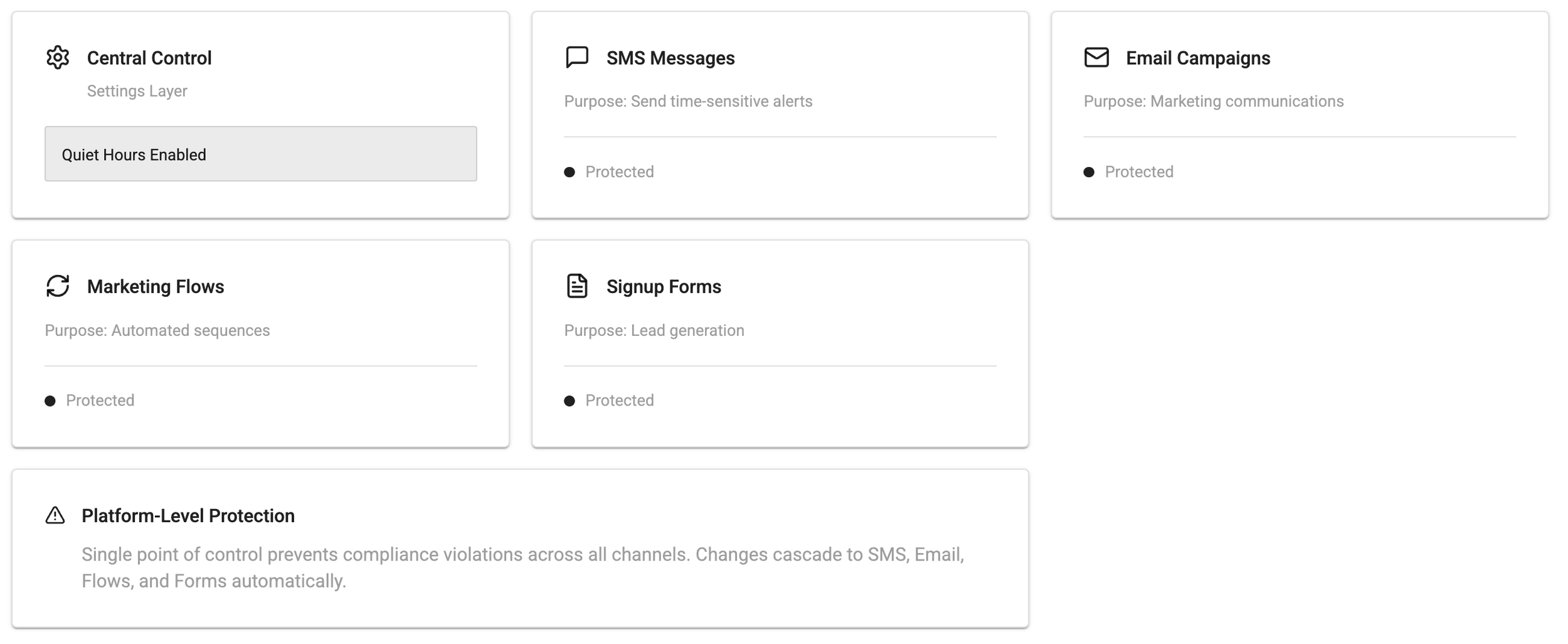
Quiet Hours acts as a centralized guardrail across all messaging surfaces, preventing communications during restricted timeframes.
Constraints & Context
High urgency: SMS compliance failures carry outsized financial and reputational risk.
Global complexity: Laws vary by country and region; the safest interpretation must often win.
Timezone ambiguity: Quiet Hours must be enforced at the recipient level, not the send time level.
Design system fidelity: All solutions had to use Klaviyo’s existing design system.
Velocity bias: The feature needed to ship quickly to reduce platform risk.
Distributed team: PM and I were co-located; Content and Design leadership were remote.
There was no generative user research. Instead, we relied on:
Competitive analysis
Internal subject-matter experts (legal, deliverability)
Platform data and support insights
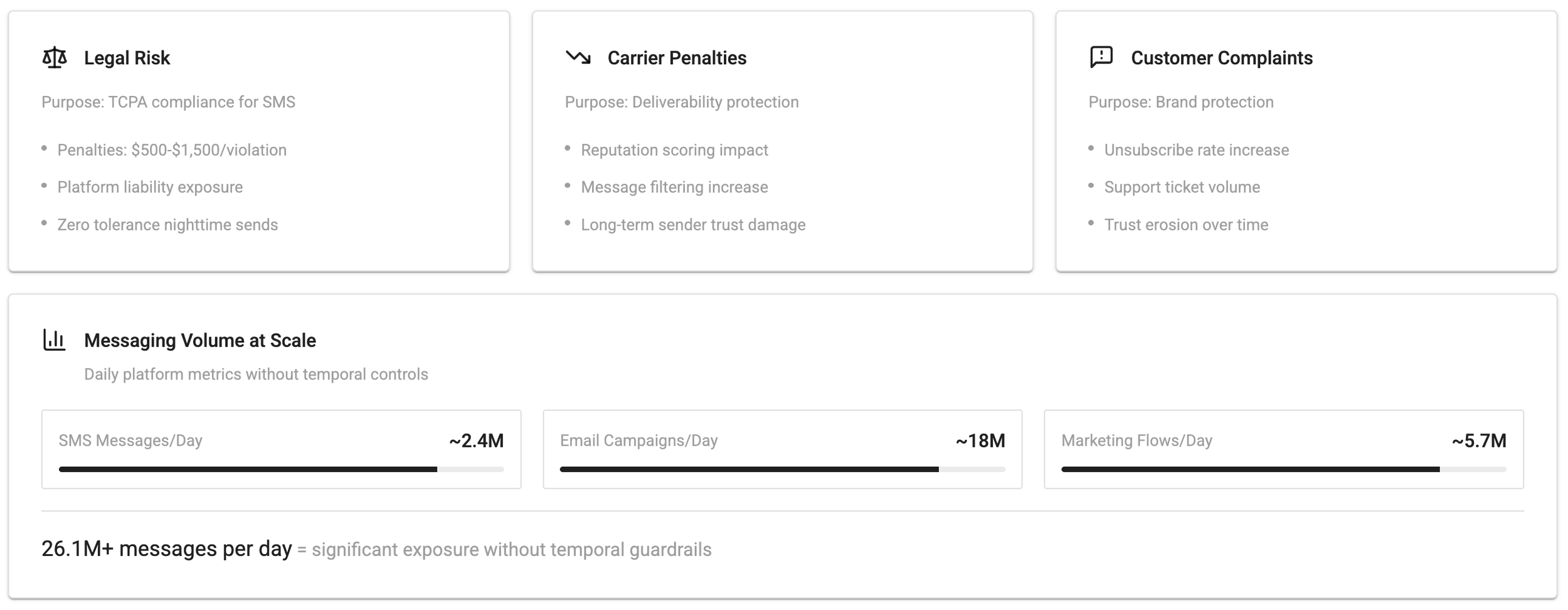
High-volume messaging without temporal controls creates legal, operational, and deliverability exposure.
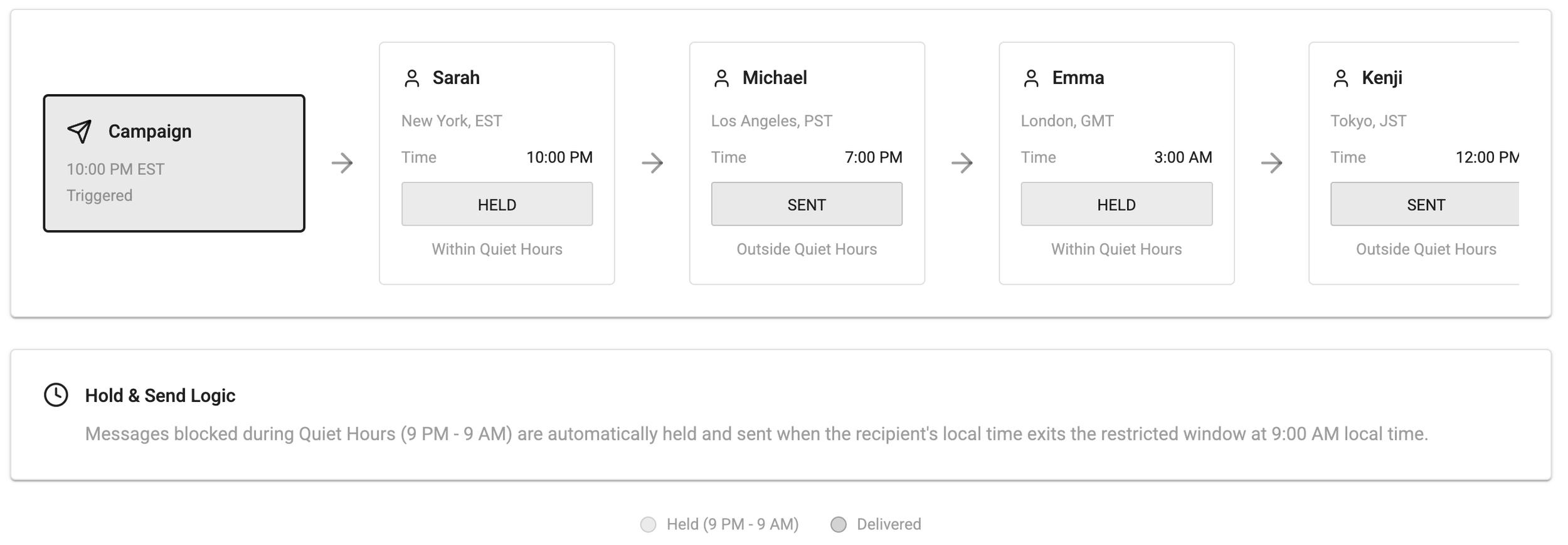
A single campaign triggered at one time reaches recipients across multiple time zones. Quiet Hours enforces hold-and-send behavior at recipient-level local times.
Design Approach
1. Alignment & Risk Framing
We began with joint PM–Design sessions to align on:
The regulatory and carrier risks of Quiet Hours need to be mitigated
The failure modes we were explicitly designing against
What not to solve in v1 (e.g., per-campaign overrides)
This framing helped us avoid building a flexible but dangerous system.
2. Decision
Centralized global control instead of per-campaign settings:
Embedding Quiet Hours at the campaign or flow level would have increased flexibility but also increased the likelihood of accidental non-compliance.
Centralizing control reinforced Quiet Hours as a safety policy rather than an optimization tool.
3. Recipient-Level Enforcement
A key design consideration was that Quiet Hours are enforced per recipient, not per send.
This meant the system needed to account for:
Recipient location and inferred timezone
Cross-border phone numbers
Daylight saving changes
Incomplete or imperfect data
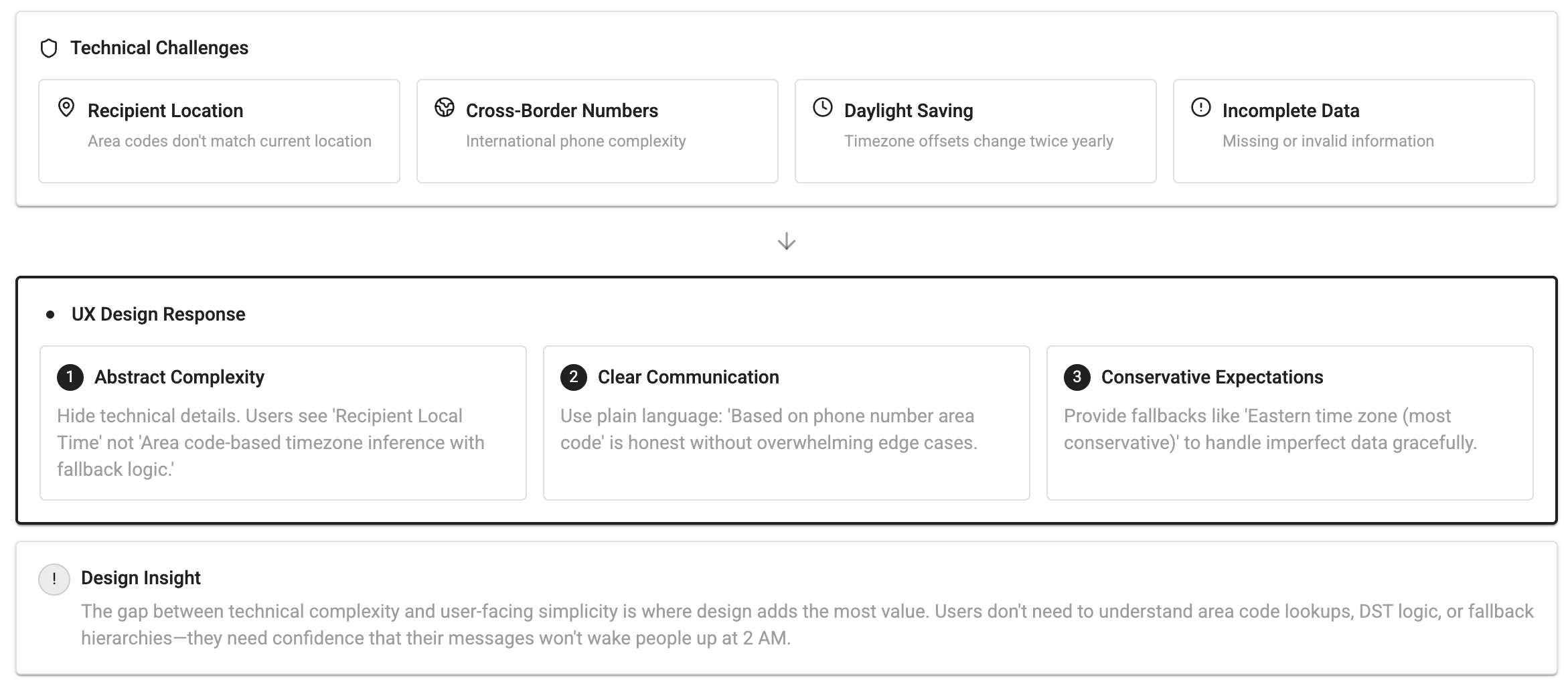
From a UX perspective, this required:
Abstracting extreme technical complexity
Communicating behavior clearly without exposing implementation details
Setting conservative expectations to avoid false confidence
4. Structured Divergence
I explored three concepts:
Concept A — Out-of-the-Box:
Minimal configuration using existing Settings patterns.Concept B — Guardrails-First:
A “think big, ship small” approach that prioritized safety, defaults, and future extensibility.Concept C — Advanced Control:
More expressive configuration with higher engineering effort, still system-compliant.
All concepts intentionally avoided bespoke UI patterns or one-off logic.
Given the risk profile, we selected the concept that maximized:
Predictability
Speed to production
Platform-wide safety
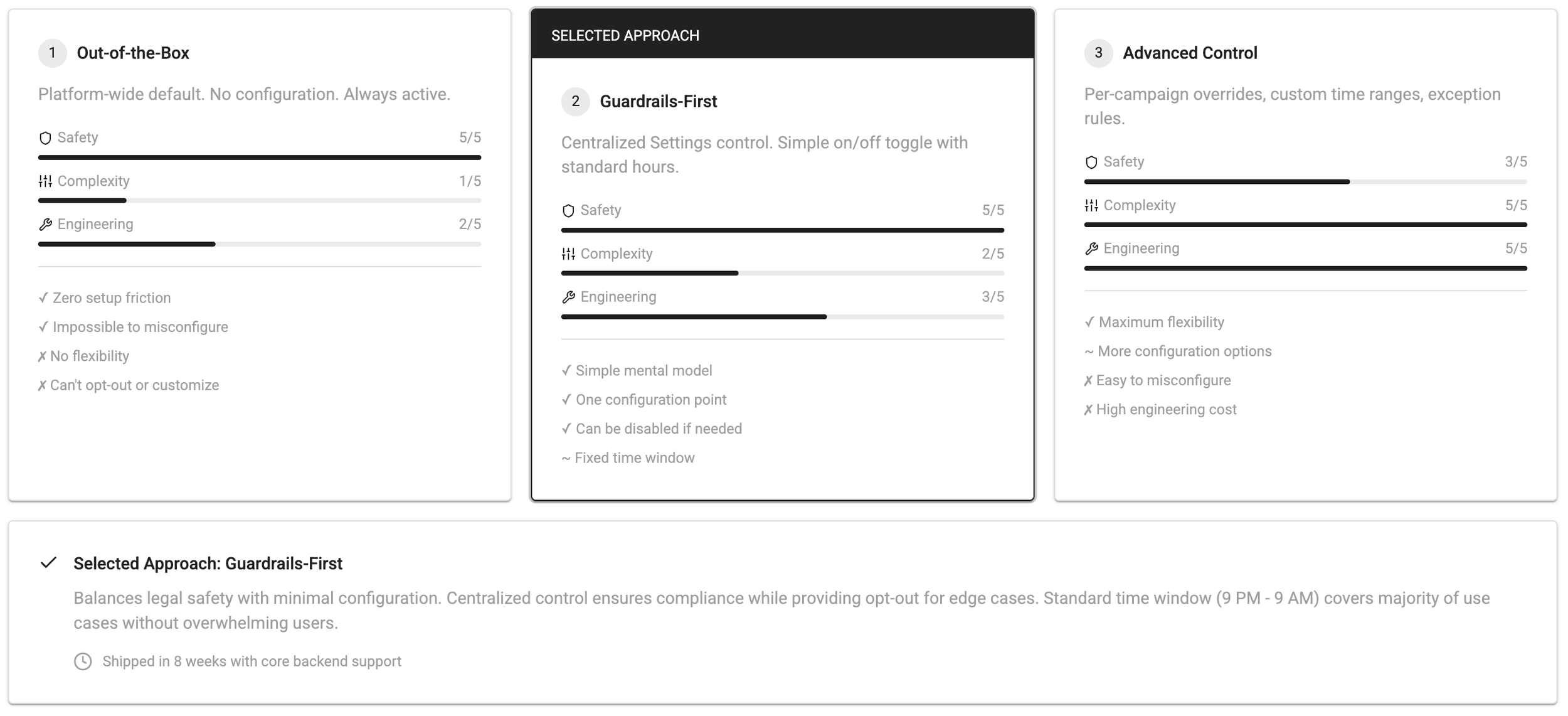
Exploring the spectrum from simple defaults to advanced control, balancing safety, complexity, and engineering effort.
Solution
Quiet Hours shipped as a centralized Settings feature that allows brands to define restricted sending windows.
Key characteristics:
Enforced automatically at the recipient’s local time
Defaults aligned with conservative legal interpretations
Clear explanatory copy co-designed with Content
Applied consistently across relevant messaging surfaces
No per-object overrides in v1 to preserve compliance integrity
Outcome
Shipped and live
Reduced legal and compliance risk for brands
Improved SMS deliverability and carrier trust
Lowered support and escalation volume
Established a scalable foundation for future policy controls
Quiet Hours became a mutual safety feature that protected brands, end customers, and Klaviyo’s platform health simultaneously.

Reflection
Quiet Hours reinforced a core belief in my design practice:
This project reinforced that in enterprise platforms, velocity is a risky decision.
Shipping a smaller, conservative system quickly often provides more real protection than designing a flexible solution that arrives too late.